Diagnosis, door reverses on closing
Garage door closes then reopens straight away
Not dangerous, but do not defeat the safety system
Short answer first: an automated door that starts closing and then travels back up has decided something is in its path. That decision comes from one of two places, the photocell beam across the opening, or the operator sensing more resistance than its force setting allows.
Neither of those is a fault in itself. They are the features that stop a door closing on a child, a bicycle or a bumper. The job is to find out what is triggering them, rather than to switch them off.
Rule out the obvious first
Stand inside with the light on and watch the full closing run. In many call-outs the answer is visible in ten seconds.
- A bin, wheelbarrow handle or garden hose clipping the beam near the floor.
- Cobwebs, frost or a smear of mud across one photocell lens.
- A photocell knocked out of alignment by a car door or a strimmer.
- Leaves and grit built up in the floor channel so the door meets the ground early.
- Direct low sun shining straight into the receiving lens on bright mornings.
When the beam is clean but it still reverses
Wipe both lenses with a dry cloth and check the indicator lamps on each unit. Most makes show one steady light on the transmitter and one on the receiver when the pair are aligned; a flashing or absent light points to alignment or wiring rather than an obstruction.
If the reversal happens at exactly the same height every time, suspect the mechanics instead. A dry roller, a bent track section or a curtain that has crept sideways all raise resistance at one predictable point, and the operator reads that spike as an impact.
Force and travel limits
Operators are commissioned to a particular door with particular weight and friction. As seasons change and grease stiffens, the real resistance drifts away from the commissioned figure, and the door starts reversing without anything being in the way.
Re-setting force and travel is straightforward for an engineer and is part of what we do on a service visit. It is worth saying plainly that turning force up to push past a genuine obstruction is the wrong answer, it removes the protection the setting exists to provide.
The one version that needs an engineer quickly
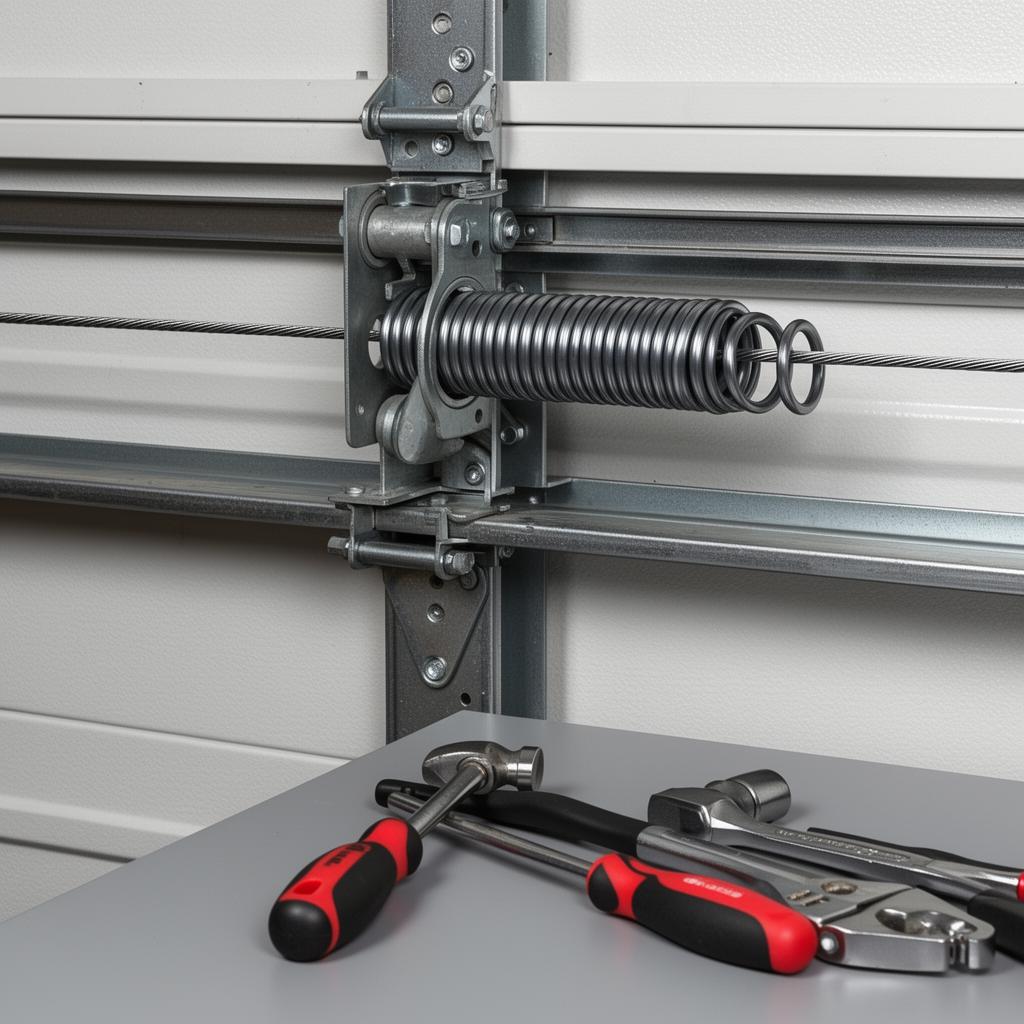
If the door reverses and you can also hear a clatter, see a slack lift cable, or see one side sitting lower than the other, stop using it. Springs and cables are under high tension and are not a DIY item; a snapped cable can whip and a released spring carries enough energy to break bones.
We cover Northern Ireland around the clock from Dromore, so a door in that state can be made safe the same day rather than left half shut overnight.
What we do on the visit
We test the safety edge and photocells, clean and realign them, check roller and track condition through the full travel, verify curtain or panel alignment, then re-commission force and limits and run repeated close cycles to prove the fix rather than assume it.
Questions we get asked
- Can I just disconnect the safety sensors?
- No. They are the reason a closing door stops instead of trapping someone. If they are misreading, they need cleaning, aligning or replacing, not bypassing.
- Why does it only happen in the morning?
- Cold stiffens grease and raises friction, and low sun can dazzle a photocell. Both push the operator over its reversal threshold at a particular time of day.
- It reverses at the same point each time. Meaning?
- A repeatable position points at a mechanical cause at that height, typically a dry or flat-spotted roller, a distorted track or a door that has shifted in its guides.
- Could a new remote have caused it?
- Unlikely. Remotes send an open or close command; they do not control the reversal logic. Look at sensors, friction and force settings instead.
- Is it safe to keep using in the meantime?
- If it reverses cleanly and nothing looks slack or crooked, yes, though you are relying on the safety system daily. Anything involving cables or springs means stop and call us.
Door bouncing back open? We will find why
Sensor, friction or force setting, we test the whole closing run rather than guess. 24/7 cover across Northern Ireland.
Based at 31 Mount Street, Dromore (BT25) · covering Northern Ireland · 24/7 emergency repairs