Understanding garage door parts and hardware
Garage door parts and hardware: what each part does
Garage door hardware is everything except the door leaf itself: the springs that counterbalance the weight, the cables and drums that transfer it, the rollers, hinges and tracks the door runs on, the lock, and the motor if it is automated. Knowing what each part does makes it much easier to describe a fault and to understand a repair quote.
The parts differ by door type. An up and over door, a sectional door and a roller door each use a different lifting system, so this guide groups the hardware by what it does and notes where it varies. We repair and replace these parts across Northern Ireland as part of our repair service.
- Lifting
- Springs, cables, drums
- Guiding
- Rollers, tracks, hinges
- Securing
- Locks and motor drive
- Wear first
- Springs, rollers, seals
Lifting hardware: springs, cables and drums
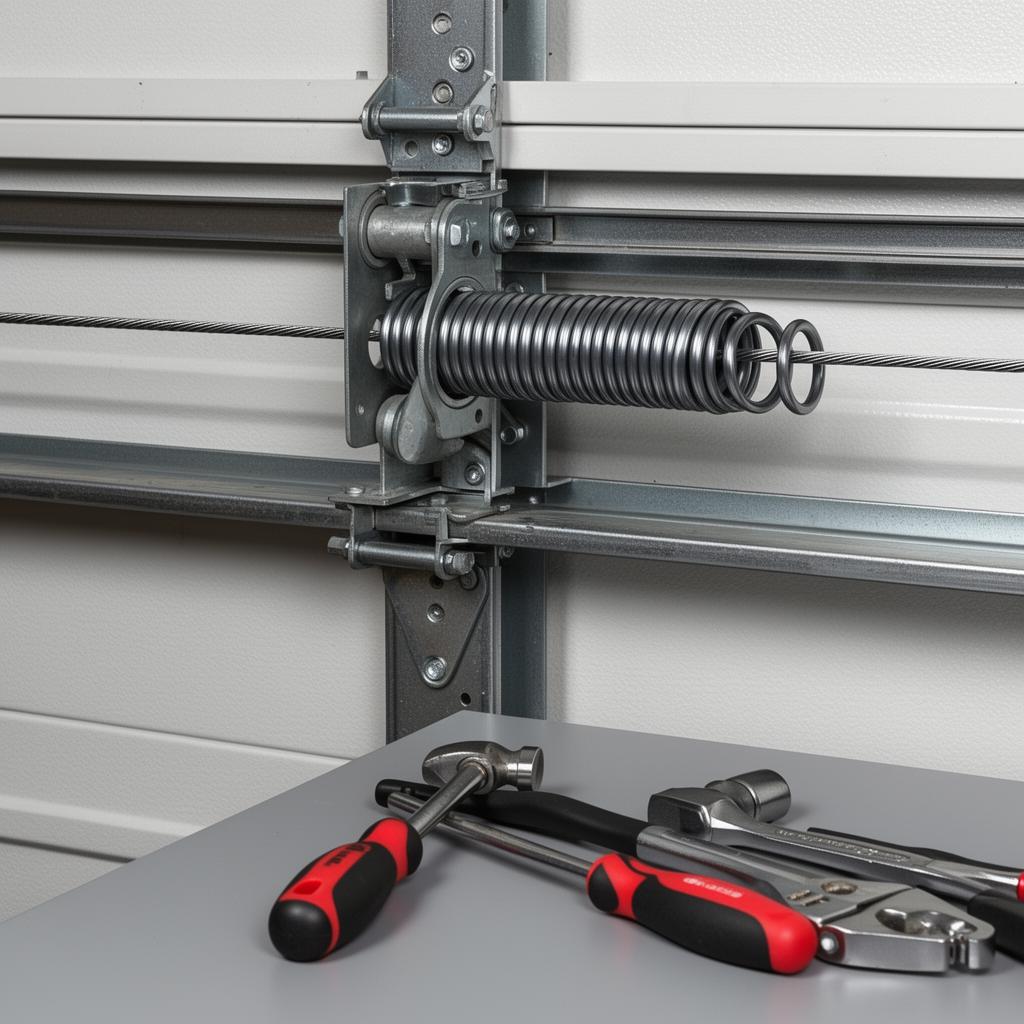
Springs do the heavy lifting on almost every garage door. Sectional doors use torsion springs on a shaft above the opening; many up and over doors use tension springs or a cone spring at the sides; roller doors use a spring inside the barrel or rely on the motor. Cables connect the bottom of a sectional door to drums on the spring shaft, winding on and off as the door moves.
These parts carry stored energy and are the ones that fail suddenly. A spring reaches the end of its life after a certain number of cycles, and a frayed cable can let go without warning. Replacing them needs the right tools and a way to hold the tension safely, so they are strictly an engineer's job.
Guiding hardware: rollers, tracks and hinges
Rollers run in the tracks and carry the door along its path. They come in nylon and steel; nylon is quieter, steel is tougher. Tracks are fixed to the wall and ceiling and must stay parallel and plumb. On sectional doors, hinges join the panels and let the door bend round the curve of the track.
- Worn rollers show up as rumbling, juddering or flat spots.
- Bent tracks cause the door to stick at the same point every time.
- Cracked hinges let a gap open between panels.
- Loose fixings make the whole door rattle in wind.
Securing hardware: locks, handles and the motor
Manual doors rely on a lock and handle, often a central lock with rods to the sides on up and over doors. Automated doors are held closed by the motor's drive, and many have an internal release so they can be opened by hand in a power cut. Our lock replacement and security guides go into the options in more depth.
Parts by door type
The main hardware differs from one type of door to the next.
| Door type | Lifting system | Parts that wear most |
|---|---|---|
| Up and over | Side springs or counterbalance | Springs, pivots, lock rods |
| Sectional | Torsion springs, cables, drums | Springs, cables, rollers, hinges |
| Roller | Barrel spring or motor | Guide rails, brush seals, motor |
| Side-hinged | Hinges only | Hinges, bolts, lock |
Seals and weatherstrips
Seals are hardware too, even if they are rubber. Bottom seals, side seals and top seals keep out rain, leaves and draughts. They perish with sunlight and frost and are among the cheapest parts to renew, which makes them one of the best value repairs on an older door.
When a part is no longer available
Older doors, and doors from firms that have stopped trading, can be hard to find parts for. Sometimes a compatible part from another make will fit; sometimes it will not. When the key parts cannot be sourced, replacement becomes the sensible option, and we will explain that plainly rather than fit something that will not last.
Questions we get asked
- Which garage door parts wear out first?
- Springs, rollers and seals, in most cases. Springs have a set working life, rollers wear with use, and seals perish with weather.
- Can I replace garage door springs myself?
- We strongly advise against it. Springs and cables carry stored tension and can cause serious injury if released. Have an engineer do it.
- Do you supply parts on their own?
- Our service is repairing and fitting. If you need a part changed, we supply and fit it as a repair so it is set up correctly.
- How do I know which parts my door uses?
- The door type tells you most of it. If you are not sure of the make, the engineer can identify it on a visit.
- Is lubricating the hardware worth doing?
- Light lubrication of hinges, rollers and pivots helps. Avoid greasing tracks, which just collects dirt. Our maintenance checklist lists what to do.
Need a part replaced?
Tell us the door type and what it is doing, and we will arrange a repair to replace and set up the part properly.
Based at 31 Mount Street, Dromore (BT25) · covering Northern Ireland · 24/7 emergency repairs