Understanding spring and cable systems and their risks
Garage door springs and cables: how they work and why they fail
Most people never think about garage door springs until one snaps, usually with a loud bang and a door that suddenly feels twice as heavy. Springs, not the motor, do almost all the work of lifting a garage door; the motor simply drives what the spring has already balanced.
Understanding the two common spring types and how cables fit into the system helps explain both the noise your door makes as it ages and why this is the one area we will not talk you through over the phone.
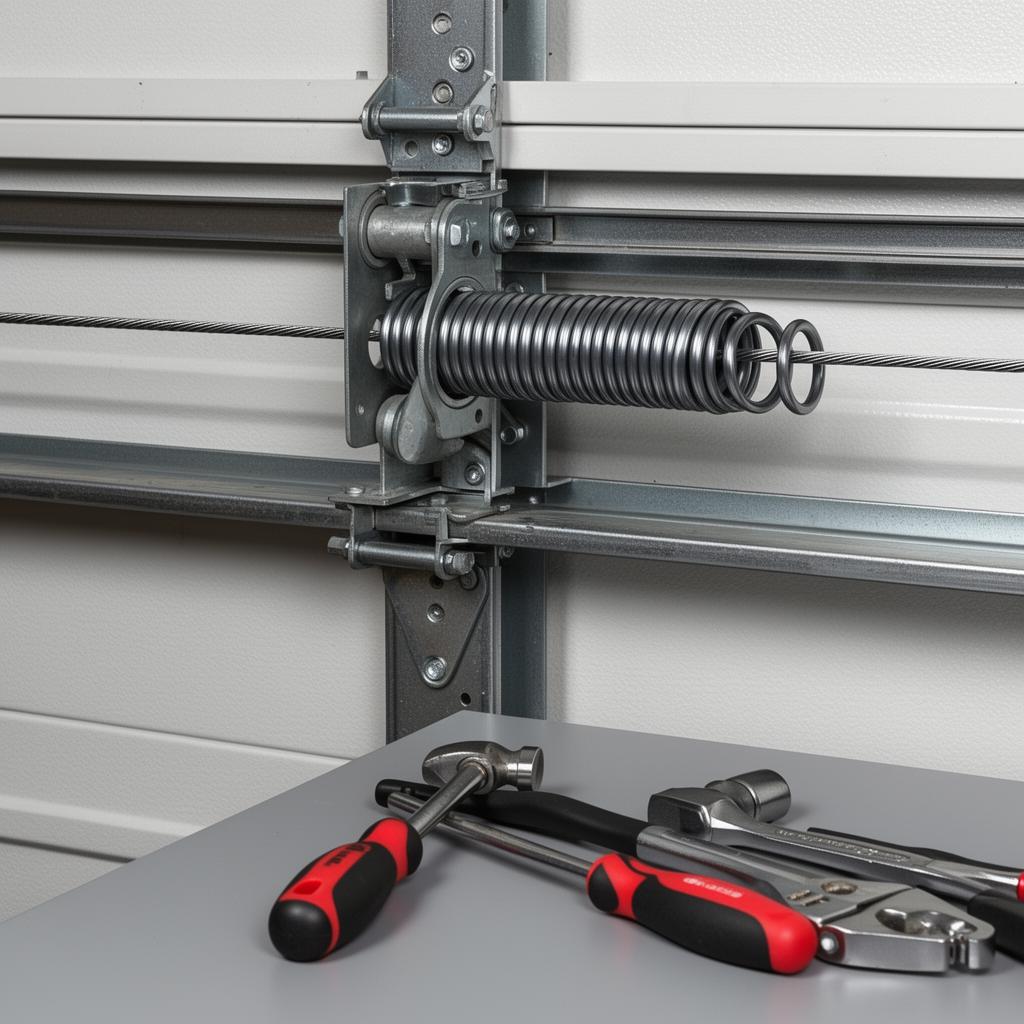
Torsion springs versus extension springs
Torsion springs sit on a shaft above the closed door and wind up as the door closes, storing energy that unwinds to help lift it. They are the standard on most modern sectional and roller systems because they are more controlled and put less strain on the tracks.
Extension springs run alongside the horizontal tracks and stretch as the door closes. They were common on older up-and-over doors and are still found on some. They work well but, without a safety cable through the centre, a snapped extension spring can fly across the garage.
How the two compare
Neither type is inherently better, they suit different door constructions.
| Torsion spring | Extension spring | |
|---|---|---|
| Location | Above the door, on a shaft | Alongside the tracks |
| Common on | Sectional and roller doors | Older up-and-over doors |
| Typical cycle life | Around 10,000, 15,000 cycles | Around 7,000, 10,000 cycles |
| Failure behaviour | Contained by the shaft | Needs a safety cable to prevent it flying loose |
| Adjustment | Requires winding bars and training | Simpler but still under real tension |
What cables do
Lift cables connect the bottom corners of the door to the spring drums or pulleys and carry the door's weight during travel. They are made from galvanised steel wire and, like springs, weaken gradually through fraying rather than failing without warning in most cases.
A fraying cable often shows itself as a door that hangs slightly crooked or one side that lifts a fraction later than the other, which is worth reporting before it snaps rather than after.
Cycle life and what shortens it
Springs and cables are rated in cycles, one cycle being a full open and close. A typical household door does two to four cycles a day, which is why most springs last eight to twelve years before fatigue sets in. Doors used far more often, for example a garage that doubles as a workshop entrance, wear through that rating faster.
- Rust from a damp or unheated garage accelerates spring fatigue.
- An unbalanced door forces the motor and springs to work harder than designed.
- Salt-laden coastal air corrodes cable strands faster than inland locations.
- Frequent full-cycle use, more than six times a day, shortens life noticeably.
Why DIY spring repair is genuinely dangerous
A wound torsion spring stores enough energy to cause serious injury if released uncontrolled, and the winding bars used to tension it require specific technique. Extension springs without a safety cable have caused significant harm when they let go under tension. This is not a job where confidence with a socket set is enough.
We carry the correct winding bars, tension gauges and safety cables for the door types we work on, and pricing for spring and cable replacement is set out on our repair costs guide.
Questions we get asked
- How do I know if a spring has failed rather than the motor?
- A door that suddenly feels very heavy to lift by hand, or a motor that hums and struggles without moving the door, both point to a spring problem rather than a motor fault. A loud bang from the garage is a strong indicator too.
- Should I replace one spring or both?
- Torsion springs are almost always replaced as a pair, since they are fitted and age together and the second is usually close behind the first. This also keeps the door balanced evenly on both sides.
- Can a cable be repaired or does it need full replacement?
- A frayed or snapped cable is replaced rather than repaired, since a repaired cable cannot be trusted to carry the door's full weight reliably.
- How long does a spring or cable replacement take?
- Most single-door jobs are completed within an hour once an engineer is on site, assuming standard parts are in stock on the van.
- Is it safe to keep using the door with a fraying cable?
- No. A fraying cable can let go without further warning and the door can drop suddenly, which is a real risk to anyone underneath. Stop using the door and book a repair.
- Do you offer a warranty on replaced springs and cables?
- Yes, parts we fit carry a manufacturer or supplier warranty, and we can confirm the specific terms for your door at the time of repair.
Do not attempt a spring repair yourself
Book an engineer to replace springs or cables safely, with the right tools and a written price before we start.
Based at 31 Mount Street, Dromore (BT25) · covering Northern Ireland · 24/7 emergency repairs