Material choice for wind, rain and salt exposure
Choosing a garage door for a wind-exposed or coastal property
A door that will last twenty years on a sheltered street in a town can look tired within five on a headland or an open rural hillside. Nothing is wrong with the door; the conditions are simply harsher, and the specification was written for the wrong ones.
Three things do the damage in Northern Ireland: sustained wind on a large flat panel, rain driven horizontally into seals and joints, and salt-laden air that finds any break in a coating. This guide covers what to change in the specification, and the small maintenance habits that make the largest difference.
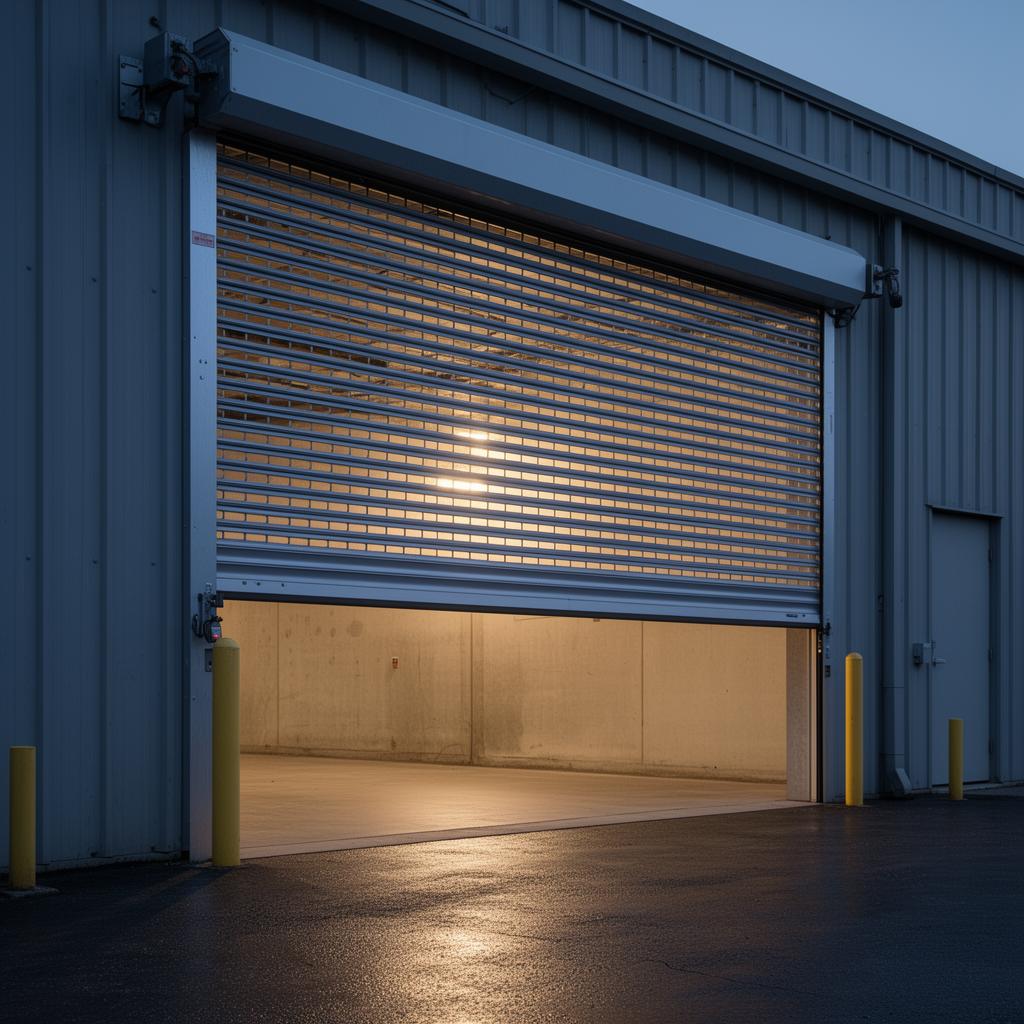
- Main wear driver near the sea
- Salt-laden air on coatings
- Wind load
- Rises with door width
- Most vulnerable point
- Cut edges and fixings
- Simplest protection
- Regular fresh-water rinsing
Wind: why width matters more than height
A garage door is a large flat surface with a modest structure behind it. Wind pressure across that surface increases with area, and because doors grow wider more often than taller, width is usually what pushes a door beyond what its panel stiffness and guides were designed for.
The symptoms are recognisable long before failure: a door that drums and flexes in gusts, that pulls out of its guides at one corner, or that whistles along a seal. On exposed sites these are specification signals, not quirks to live with.
- Prefer stiffer panel construction, double-skin sections or reinforced slats, on wide exposed openings.
- Ask what wind-resistance class a door carries rather than assuming any door suits any site.
- Deeper guides hold a roller curtain more securely under pressure.
- Fixings into sound structure matter as much as the door itself; a strong door on weak fixings still fails at the fixings.
Driving rain and where water actually gets in
Water rarely comes through a panel. It gets in at the threshold, past perished side seals, or up under a bottom seal when wind pressure lifts it, which is why a coastal garage can be wet inside after a storm despite an apparently sound door.
On exposed elevations, seals are a wear item with a shorter life than the door and should be inspected annually rather than left until a puddle appears. A slight fall on the threshold, or a rebated opening that shelters the seal line, does more good than an expensive door fitted into an unsheltered flush opening.
Salt air, coatings and cut edges
Salt accelerates corrosion wherever a protective coating is broken. On a factory-finished steel door, the vulnerable places are not the flat faces but the cut edges, drilled holes, screw heads, hinge points and any scratch from a wheelie bin or ladder.
This is why two identical doors on the same coastal road can age very differently. One was fitted with edges dressed and fixings appropriate to the environment; the other has a rust bloom starting at four screw heads within two winters.
- Choose stainless or suitably coated fixings on coastal installations rather than standard steel.
- Have cut edges and drilled penetrations treated at installation, not left bare.
- Touch up scratches and impact chips quickly; open steel near the sea does not stay superficial for long.
- Aluminium components resist salt well but still corrode where they contact dissimilar metals.
How the materials compare in exposure
No single material is the automatic answer. The right choice depends on how exposed the elevation is, whether it takes salt spray directly, and how much routine care the owner is realistically going to give it.
| Material | In exposure | What it needs |
|---|---|---|
| Coated steel | Good while the coating stays intact | Prompt repair of chips and scratches |
| Aluminium | Strong salt resistance | Care where it meets other metals |
| Timber | Attractive but weathers fastest | Regular refinishing on the weather face |
| GRP | Very stable in salt air | Little beyond cleaning |
Automation and electrics near the coast
Motors and control gear are not immune to the environment. Salt-laden damp air reaches enclosures, terminals and photocell lenses, and corrosion at a connection is a far more common cause of intermittent behaviour on coastal doors than a failed motor.
Where a door is automated on an exposed site, position control gear away from direct spray, keep cable entries sealed downwards, and treat photocell lenses as something to clean rather than something that either works or does not.
A maintenance routine that suits the location
Coastal maintenance is unglamorous and effective. Rinsing salt off the door face and guides with fresh water, more often in winter, removes the thing doing the damage before it concentrates at edges and fixings.
Add a seasonal look at seals, guides and fixings, and deal with small damage immediately rather than at the next service. Exposure punishes deferral more than it punishes any particular material choice.
- Rinse the door face, guides and threshold with fresh water through the winter months.
- Inspect seals after each significant storm rather than on a fixed schedule.
- Check fixings and hinge points for early rust bloom twice a year.
- Keep the threshold clear of sand, grit and debris that hold moisture against the seal.
General guidance, not a site assessment
Everything above is general and factual, and it applies broadly across exposed Northern Ireland sites. It is not a substitute for looking at your particular elevation, because the same road can have a sheltered side and a punished one.
If your property is genuinely exposed, say so when you ask for a quote. It changes what we recommend, and it is much cheaper to specify correctly at the start than to revisit a door that was never suited to where it was fitted.
Questions we get asked
- Is there such a thing as a fully corrosion-proof garage door?
- No, but there are combinations that hold up far better, such as aluminium or GRP construction with appropriate fixings and well-protected edges. Even those benefit from rinsing and prompt repair of damage.
- How far inland does salt exposure matter?
- It reduces with distance and shelter, and there is no fixed boundary. If you can taste salt on the air in onshore winds or see salt film on windows, it is worth treating the site as coastal for specification purposes.
- Does a wider door need a stronger specification just for wind?
- Generally yes. Wind pressure acts across the whole door area, so widening an opening increases the load the panel, guides and fixings carry even if nothing else about the site changes.
- Should I avoid timber entirely on a coastal property?
- Not necessarily, but be honest about maintenance. Timber on a weather-facing elevation near the sea needs refinishing more often than most owners plan for, and it looks poor quickly once that slips.
- Will a coastal specification cost noticeably more?
- The differences are usually in fixings, edge treatment, seals and panel construction rather than a wholly different door, so the change is modest relative to the whole job and far cheaper than early replacement.
Tell us how exposed the opening is when you enquire
Mention distance from the coast, which way the door faces and how sheltered it is, and we will specify materials, fixings and seals suited to those conditions rather than a standard build.
Based at 31 Mount Street, Dromore (BT25) · covering Northern Ireland · 24/7 emergency repairs