Product research on up-and-over doors
Up and over garage doors: canopy vs retractable
Up and over doors were the standard fit across Northern Ireland housing for decades, and a great many are still in service on estates from Lisburn to Portadown. The single panel tilts and slides forward on a track before lifting flat under the ceiling, a simple mechanism that is cheap to make and, when new, straightforward to operate.
This guide explains the two mechanisms sold under the up and over name, why they remain a common choice, the practical drawbacks worth knowing before you buy one, and how to judge whether your existing door has reached the end of its useful life.
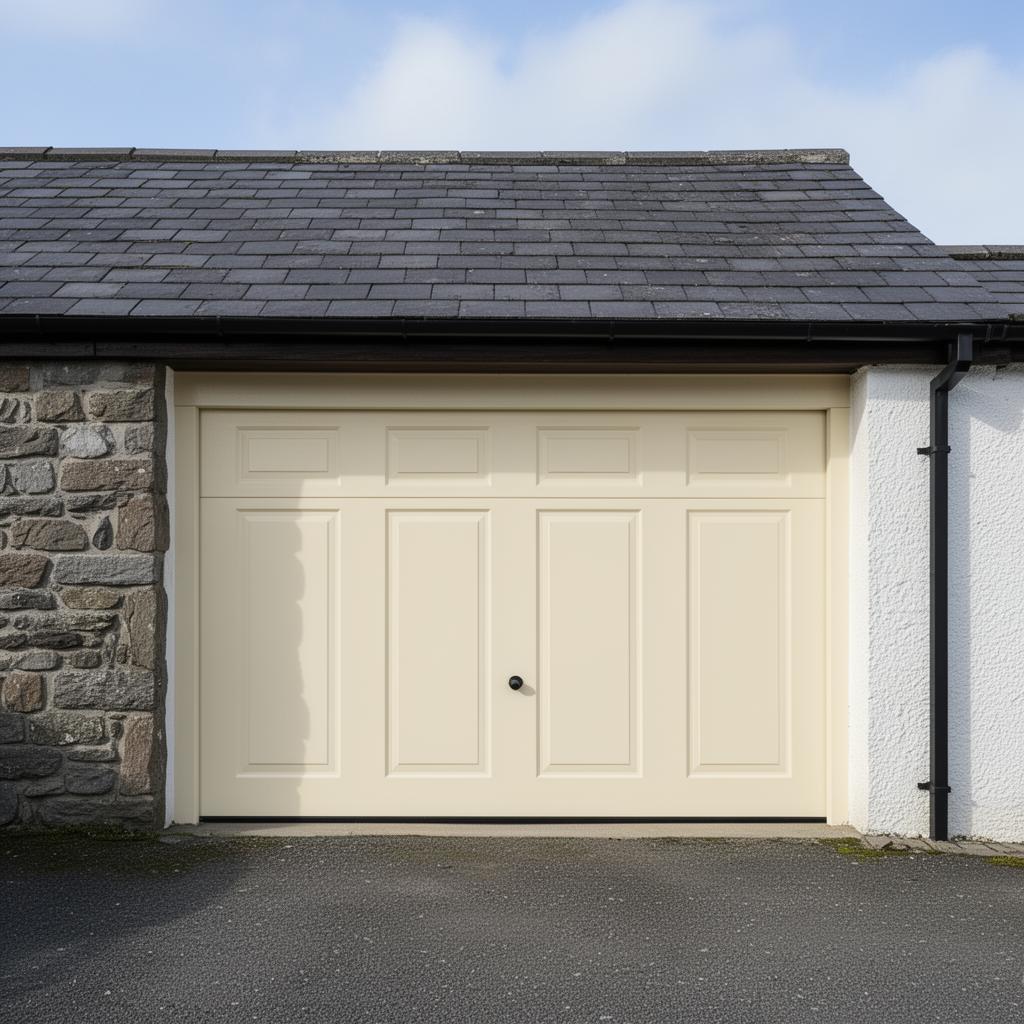
- Typical fitted range
- £800, £1,400
- Mechanism types
- Canopy or retractable
- Driveway clearance
- Panel swings out on opening
- Typical lifespan
- 15 to 25 years with servicing
Canopy vs retractable, the actual difference
A canopy door has around a third of the panel projecting outside the garage when closed, and the whole panel tilts out and up as one piece, with the track fixed to the panel itself. A retractable door has the full panel inside the garage line when closed, and it slides back on tracks fixed to the frame before lifting, giving a slightly larger clear opening and a marginally better seal.
Retractable mechanisms are generally the better specification of the two, with a more even weight distribution and, on most ranges, a sturdier frame, though canopy doors remain common because they are usually the cheaper option.
Why up and over doors remain popular
The main draw is cost. An up and over door is mechanically simple, widely available, and cheaper to manufacture than a sectional, which keeps the fitted price attractive on a budget replacement. Spares are also easy to source for common models, which matters on a straightforward like-for-like swap.
For a detached, unheated garage where insulation and a premium feel are not priorities, an up and over remains a perfectly reasonable, cost-effective choice.
The drawbacks worth knowing
Set against rollers and sectionals, up and over doors have real limitations that are worth weighing before you buy on price alone.
- The panel swings out as it opens, so a car parked close to the door, or a short driveway, can be a genuine obstruction.
- Single-skin panels offer little insulation, a poor fit for an attached or converted garage.
- Springs carry more of the load on a single large panel, and a failed spring on an up and over is a common, sudden fault.
- Weather sealing at the sides is typically weaker than a sectional's compression seals, which shows up as draughts and water ingress over time.
Signs your old up and over needs replacing
A door that has dropped slightly on one side, is increasingly heavy to lift, or has visible rust bubbling through the paint at the base is nearing the end of its service life. Repeated spring failures on the same door are also a sign the mechanism as a whole is tired rather than the spring being an isolated fault.
If the frame itself has rotted or rusted where it meets the brickwork, replacement is almost always more sensible than repair, since a new door will not seal properly against a failing frame.
Replacing like for like or upgrading the format
Many people replacing an old up and over choose a compact roller, which fits the same opening, needs comparable headroom, and removes the swing-out clearance problem entirely. Others stay with an up and over on a tight budget, simply upgrading to a better-sealed, foam-filled panel.
We will give you a genuine comparison on your specific opening rather than steering you towards whichever is easiest for us to fit.
Canopy vs retractable at a glance
A short summary of the two mechanisms.
| Canopy | Retractable | |
|---|---|---|
| Panel position when closed | Part projects outside | Fully within garage line |
| Track fixing | Fixed to the panel | Fixed to the frame |
| Typical cost | Lower | Slightly higher |
| Seal quality | Adequate | Slightly better |
Questions we get asked
- Can an up and over door be automated?
- Yes, most can take a suitable arm-driven operator, though canopy doors sometimes need bracing work first since the frame carries more of the load once motorised. We check this before quoting automation on an older door.
- Why did my spring snap without warning?
- Springs fail through fatigue after thousands of open and close cycles, and an up and over door puts more load through a single spring than a sectional's multiple springs do. Regular servicing catches most springs before they fail completely.
- Is it worth repairing an old up and over or replacing it?
- If the frame and panel are sound and only the spring or cable has failed, repair is usually the cheaper route. If the frame has rusted or rotted, or the panel has visibly dropped, replacement tends to be the better long-term value.
- Do up and over doors insulate a garage well?
- Not particularly. Single-skin panels offer limited insulation, and even foam-filled versions fall short of a double-skin sectional panel, so an attached or heated garage benefits more from switching format.
- Will a new up and over fit my existing frame?
- Sometimes, but frames vary between manufacturers and eras, so we measure carefully rather than assuming compatibility. In many cases a new frame is fitted alongside the new door for a proper seal.
- How much driveway space does an up and over need?
- Enough for the panel to swing forward and up as it opens, typically a metre or so in front of the closed position. A car parked tight to the door will obstruct it.
Replacing a tired up and over door
Book a free survey and we will tell you honestly whether a like-for-like replacement or a switch to a roller suits your opening best, with a fixed fitted price.
Based at 31 Mount Street, Dromore (BT25) · covering Northern Ireland · 24/7 emergency repairs