Specifying an industrial door for a unit or depot
Industrial door options, and how to pick the right one
Industrial doors are specified against duty, not looks. The question is rarely which door is best, it is which door survives the number of cycles the opening sees, at the width required, without becoming the bottleneck in how the site works.
This guide walks through the main families we supply and fit for industrial units, warehouses and depots, and the specification details that decide between them.
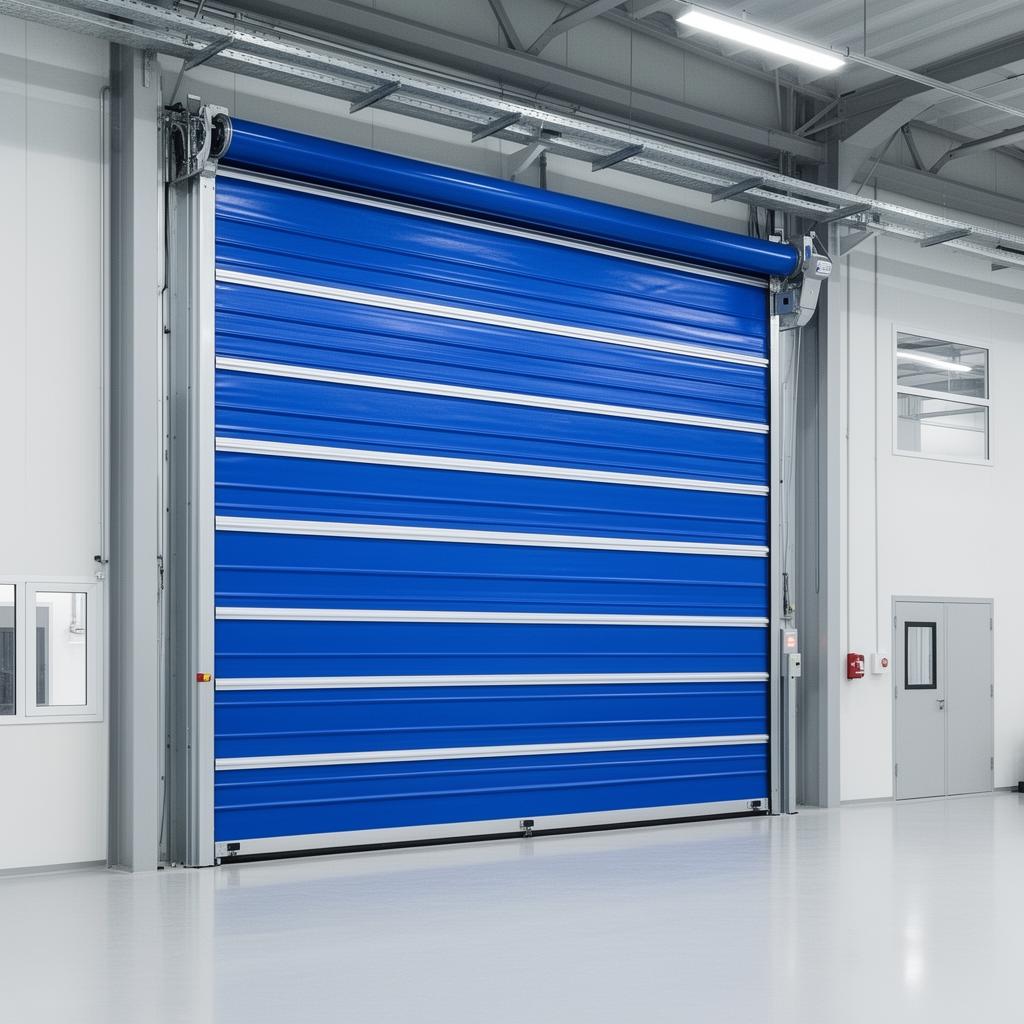
The four families you are actually choosing between
Most industrial openings resolve to one of four door families. Each has a duty profile it suits and a set of conditions where it is the wrong answer.
| Door family | Best suited to | Main limitation |
|---|---|---|
| Steel roller shutter | Wide openings, security-led, low to moderate cycles | Slower travel, limited insulation |
| Insulated sectional | Heated or temperature-sensitive space | Needs headroom and clear side room |
| High-speed door | High-cycle traffic between zones | Higher cost, needs regular servicing |
| Folding or bi-fold shutter | Very wide openings, restricted headroom | More moving hardware to maintain |
Cycle count is the specification that gets missed
A cycle is one open and one close. A shutter on a delivery bay opened twice a day is a different product from a door between a warehouse and a chilled store crossed by a forklift every four minutes, even if the opening dimensions are identical.
Underspecifying cycles is the most expensive mistake on an industrial door, because the failure does not appear as a fault, it appears as gradually rising maintenance until the door starts stopping the work. Count cycles honestly at the busiest hour, not on average.
Opening size, headroom and side room
Width and height rule some options out quickly. Sectional doors need headroom for the panel to sit horizontally and side room for the tracks, and where a building has services, gantries or a low steel beam above the opening, that space often does not exist.
Roller shutters are the more forgiving choice in tight structures because the curtain coils into a barrel above the opening, but the barrel still needs its own space and a fixing point that can carry it. On very wide openings with almost no headroom, folding shutters become the practical route.
Insulation, draughts and working conditions
A large uninsulated opening dominates the heat balance of the space behind it. On a heated production area or anywhere goods are temperature-sensitive, an insulated sectional door with proper perimeter sealing is a different proposition from a single-skin shutter, both in running cost and in how tolerable the space is to work in through winter.
Where the door must stay open for long periods, insulation on the door itself matters less than how quickly it closes. That is the argument for a high-speed door in an internal opening: the door spends less of the day being a hole in the wall.
Access, egress and traffic separation
Vehicle doors are a poor way for people to enter a building. Where staff use the same opening all day, a wicket door built into the shutter, or a separate personnel door alongside it, keeps the large door cycling only when a vehicle needs it, which extends its life and reduces risk.
Separating pedestrian and vehicle routes also decides where safety devices go. Photocells, warning beacons and edge protection are positioned around actual traffic patterns, so the flow through the opening is worth mapping before the door is specified.
- Wicket door: pedestrian access without cycling the main shutter.
- Separate personnel door: cleaner separation where wall space allows.
- Beacons and audible warning: for openings onto shared yard traffic.
- Bottom-edge protection: essential on powered doors crossing a walking route.
Powered operation and manual override
Almost all industrial doors of any size are powered. The decisions are control type and what happens when power is lost: three-button control, pull-cord, remote, induction loop or a link to a site access system, and a manual override route for evacuation or delivery in an outage.
Fire strategy also intersects here. Where a door sits in a compartment line or on an escape route, the control and release arrangement is not a free choice, so it should be settled with whoever holds the fire strategy for the building rather than at the survey.
Servicing the door you choose
Industrial doors are consumable in a way domestic doors are not. Curtains take knocks, guides collect debris, and motors work hard. A planned service interval matched to cycle count is what keeps a door from failing at the worst moment, and it is far cheaper than reactive attendance.
When comparing quotes, compare the servicing assumption alongside the door price. A cheaper door on a heavier duty than it was built for will show up as callouts within the first two years.
Questions we get asked
- How do I work out the cycle duty for an opening?
- Count openings during your busiest hour and multiply out across a working day, then add seasonal peaks. Specify to that peak figure rather than the annual average, because the peak is what wears the door.
- Can one door type cover several openings on a site?
- Sometimes, and there is a genuine advantage in standardising spares and servicing. But if the openings differ in duty or in heat separation, forcing one type across all of them usually means one opening ends up with the wrong door.
- Is a high-speed door worth it on an external bay?
- It can be where traffic is constant and heat or dust control matters, but on a low-traffic external bay the extra cost and servicing rarely pays back against a well-specified shutter.
- Do you supply doors to sizes rather than stock dimensions?
- Yes. Industrial doors are ordered to the surveyed opening from established manufacturers and fitted by our own team, so the size follows the building rather than the other way round.
- What tends to cause unplanned downtime?
- Impact damage to curtains and guides, debris in the tracks, and motors run beyond their duty rating. All three are reduced by keeping the traffic route clear and servicing on a schedule matched to actual use.
- Can existing openings be widened for a bigger door?
- That is structural work outside what we carry out, but we will survey the opening and tell you what door the current structure supports so you can take accurate dimensions to a builder or engineer.
Send us the opening sizes and the traffic through them
With dimensions, cycle counts and whether the space behind is heated, we can specify the right door family and price supply and installation for your site.
Based at 31 Mount Street, Dromore (BT25) · covering Northern Ireland · 24/7 emergency repairs